Vigie
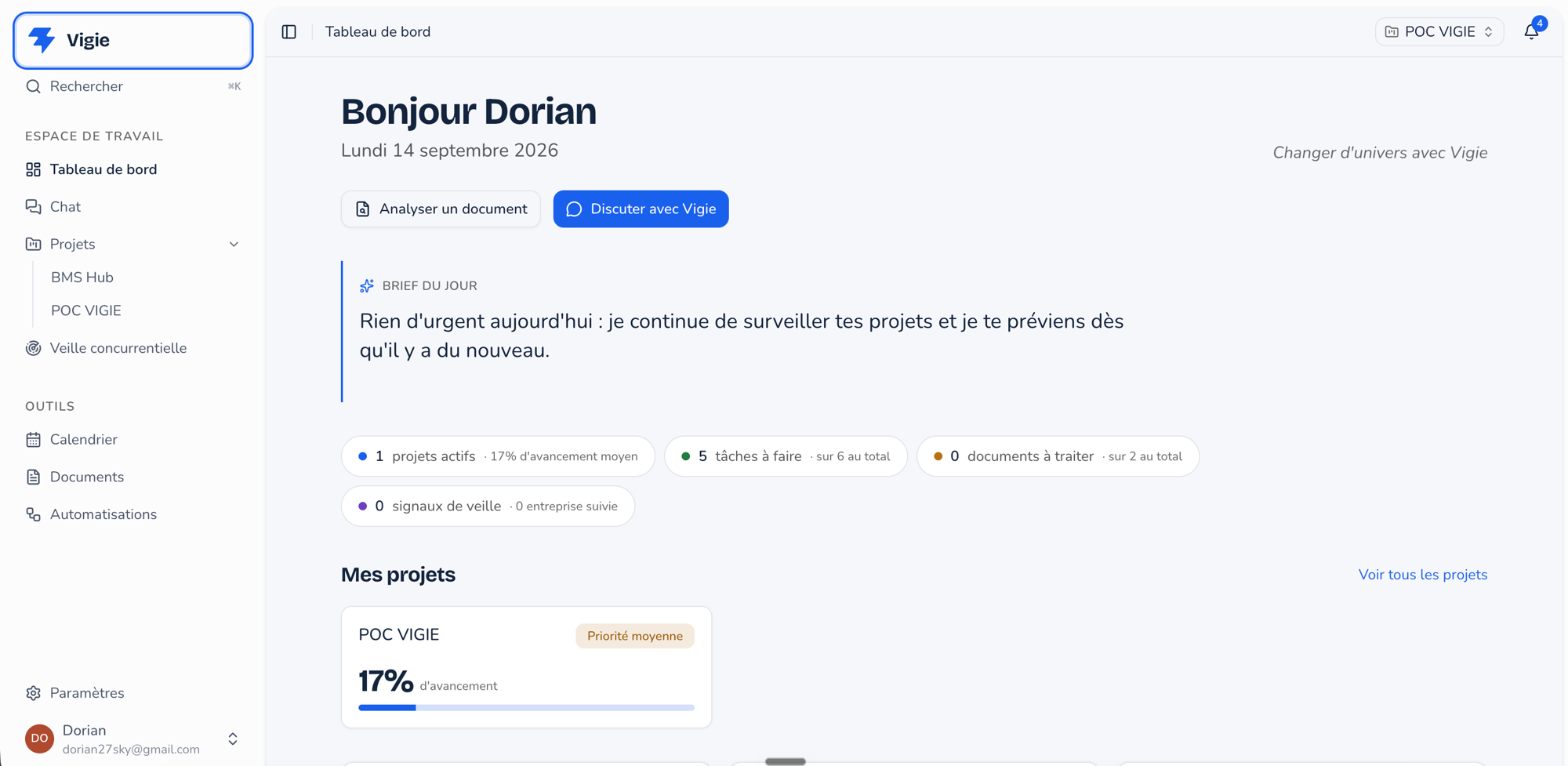
An agent that reads a team's documents — meeting minutes, specifications, tenders —, answers while citing its sources, then acts in the workspace: project created, task added, meeting scheduled. Live since August 31, 2026, by personal invitation: around ten users to date.
- Impact
- 0 actions taken without human validation, by design
- Role
- AI Product Engineer
- Stack
- Agent LLM, React, Node, PostgreSQL, OpenRouter, Security
- Keywords
- Agent, Documents, Private AI Factory
The problem
An assistant that only answers leaves all the follow-through to the user: rereading the minutes, extracting the decisions, creating the tasks, scheduling the meeting. An assistant that acts on its own, on the other hand, becomes impossible to hand over to a team — nobody signs off on a tool that writes into projects without anyone knowing what or when. Vigie is built to do both: it acts, but no action goes out without explicit approval.
The approach
A 138-line agent loop that chains reasoning, tools and response, six turns at most. Nine tools declared in a registry where each one states whether it reads or modifies — it is this declaration, not a rule written somewhere else, that triggers the validation request. The model has no access to the application: it requests a tool by naming its arguments, the browser executes. A refused action is sent back to it as is, and it takes that into account on the next turn.
All data goes through a single access point, which makes the database replaceable, and a single gateway knows the model provider: switching it only touches one file.
Security, tested before being announced
Access by personal invitation, passwords hashed with scrypt and a per-account salt, rate-limited login. An uploaded document is data to read, never an order to follow: untrusted content is fenced off and any injection attempt is flagged rather than silently executed. Database hosted in Ireland, encrypted at rest; providers that retain requests are refused on every call.
Every protection has been put to the test — access attempted without an account, passwords brute-forced one after another, booby-trapped documents uploaded to see what happens.
Cost, enforced by the server
Every call is counted in real tokens and real cost, with a cap of $10 per person per month: alert at 80%, block at 100%, reset on the 1st. With the chosen model, those $10 represent roughly fifty thousand questions — the cap protects against runaway usage, it does not ration it. The control is enforced server-side, so it cannot be bypassed from the browser.
Where it stands
Around ten people have access today, each invited by name.
- In place: the agent and its tools, traceability, the foundation and the database, budgets and quotas.
- In progress: fine-grained access control and user-selectable model choice.
- To do: connectors to existing tools — email and calendar — which will go through MCP.
Two building blocks remain in-house, the agent loop and the orchestration, because no off-the-shelf assembly would do better at this scale; authentication, for its part, is set to move to Supabase Auth.